I Know Why I Do It. So Why Do I Keep Doing It?

On overthinking, neuroplasticity, and why understanding yourself is only the beginning
Welcome. This is my first blog post, and it is especially for my intellectuals, my cerebral people and, fondly, my overthinkers.
It is a gift to possess wisdom and self-awareness. It can also feel like torture to possess all of that knowledge and have absolutely no idea how to translate it into movement.
You know why you are anxious.
You know where your people-pleasing comes from. You have identified your attachment style. You recognize that you intellectualize your emotions. You know that your childhood influenced your relationships. Maybe you can identify your triggers before your therapist can.
And yet, when the moment comes, there you are again.
Overthinking. Avoiding. Shutting down. Seeking reassurance. Choosing the familiar relationship. Abandoning the boundary you promised yourself you would hold.
So, if I understand myself so well, why am I still doing this?
That question has fascinated psychologists, philosophers, writers and probably every self-aware human who has ever lain awake at 2 a.m.
Dostoevsky writes in Crime and Punishment:
“Pain and suffering are always inevitable for a large intelligence and a deep heart.”
A little dramatic? Certainly. It is Dostoevsky.
But he understood something about the peculiar burden of human consciousness. We don't simply experience our lives. We can observe ourselves experiencing them. We remember. We anticipate. We analyze. We construct meaning. We imagine alternate futures and replay alternate pasts.
And sometimes, we confuse our ability to understand our experience with our ability to change it.
“But I already know what's wrong with me.”
This section is especially, and affectionately, for those of you who resist therapy because:
“I already know what my problem is.”
Okay.
Cough, cough.
And what have we done with that vast amount of knowledge?
I say that with genuine affection because I am familiar with intellectualization myself.
For a long time, I could have given you an extraordinarily thoughtful explanation of why I was distressed. I could talk through the circumstances, analyze someone's behavior, connect present experiences to past ones and explain exactly why something affected me.
I thought that was vulnerability.
Sometimes it was.
And sometimes I was describing the architecture of the house so thoroughly that I never had to tell you what it felt like to live inside of it.
There is an enormous difference between:
“This situation is activating an old pattern because…”
and:
“I'm hurt.”
“I'm scared.”
“I want to be loved.”
Insight can bring us to the door.
Eventually, though, we have to walk through it.
And to be clear, none of this is an argument against insight. Understanding our history can give language to experiences that once felt confusing. It can reduce shame, reveal patterns and give us choices we did not know we had.
Insight matters deeply.
But I think of insight as a map.
A beautifully detailed map can show us exactly where we are and even where we would like to go.
At some point, however, we still have to take a step.
Your brain learns through experience
This is where I find neuroscience incredibly hopeful.
The human brain remains capable of change throughout life. Neuroplasticity refers broadly to the nervous system's capacity to adapt in response to experience and learning.
This does not mean we can simply think hard enough and “rewire our brains.”
It means something simultaneously less magical and more empowering:
What we repeatedly practice matters.
Imagine I say the word apple.

Your brain doesn't encounter A-P-P-L-E as five meaningless letters. Almost instantly, an entire network of associations may become available.
Red. Green. Sweet. Crisp. A childhood kitchen. Apple pie. The smell of fall. Maybe your grandmother. Maybe a teacher.
Maybe absolutely nothing sentimental and you are currently wondering why your therapist is talking about produce.
The point is that your brain learns through association and experience.
And new learning is possible.
But new learning does not require the old learning to disappear.
This is an important distinction.
Healing is not necessarily reaching a point where the anxious thought never occurs, the old urge never appears or the familiar response becomes completely inaccessible. Sometimes change looks much quieter than that.
The thought arrives, but you recognize it sooner.
The urge appears, but there is a little more space before you act.
The emotion comes, but you can stay with yourself inside of it.
The familiar response is available, but so is another choice.
You may know that setting a boundary is healthy while every part of you experiences disappointing someone as dangerous.
You may know that you do not need reassurance while feeling an almost unbearable urge to ask one more question.
You may know that you are safe while your heart races and your body prepares to escape.
The knowledge is real.
So is the nervous system response.
And this is where healing asks something more of us than understanding.
Sometimes the body is responding before words arrive
Trauma offers an especially clear example of the gap between what we intellectually understand and what we experience physiologically.
Interoception is our ability to perceive and make sense of signals coming from within the body: heartbeat, breathing, tension, temperature, hunger, activation and other internal sensations.
Research suggests that trauma and PTSD can affect how people notice and interpret these internal signals, and interoceptive awareness appears to be closely connected with emotion regulation.
In other words, psychological suffering isn't happening exclusively in the realm of sentences and ideas.
Your body participates.
Your nervous system participates.
Your history participates.
Sometimes a response was learned before we ever had the language to explain it.
That is one reason I don't believe good therapy should exist exclusively from the neck up.
This does not mean cognition doesn't matter. It matters enormously. It means recovery may also involve learning to notice sensation, tolerate emotion, remain present when our instinct is to escape, experiment with new behavior and discover that discomfort does not always require immediate action.
We should be careful not to turn ideas like “the body keeps the score” into another oversimplified slogan.
But we should also be careful not to pretend the mind exists separately from the organism carrying it.
Understanding yourself is not the same as practicing a different way of being
This may be the most important sentence in this entire post.
Understanding yourself is not the same thing as practicing a different way of being.
Change requires practice.
Not perfection. Not constant productivity. Not turning your healing into another achievement to conquer.
Practice.
Practicing the boundary while your stomach twists.
Practicing allowing someone to misunderstand you.
Practicing noticing an anxious thought without immediately solving it.
Practicing staying present with sadness instead of explaining it.
Practicing asking for what you need.
Practicing resting without first earning it.
Practicing choosing according to your values when fear is begging you to choose according to certainty.
In Acceptance and Commitment Therapy, there is a concept called cognitive defusion: learning to experience thoughts as mental events rather than automatically treating them as literal truths, commands or facts.
ACT places this within a larger concept called psychological flexibility: our ability to remain in contact with present experience while continuing to move toward what matters to us.
I love this because it changes the goal.
The question is not always:
How do I stop having this thought?
Sometimes the more useful question is:
How do I want to live while my mind is having it?
Michael A. Singer writes in The Untethered Soul:
“You are not the voice of the mind. You are the one who hears it.”
Your thoughts arise.
Your emotions arise.
You can observe both.
Neither observation requires obedience.
You can think, They're going to reject me, and still tell the truth.
You can feel anxious and still walk into the room.
You can feel grief and still experience beauty.
You can hear the old story without allowing it to write the next sentence.
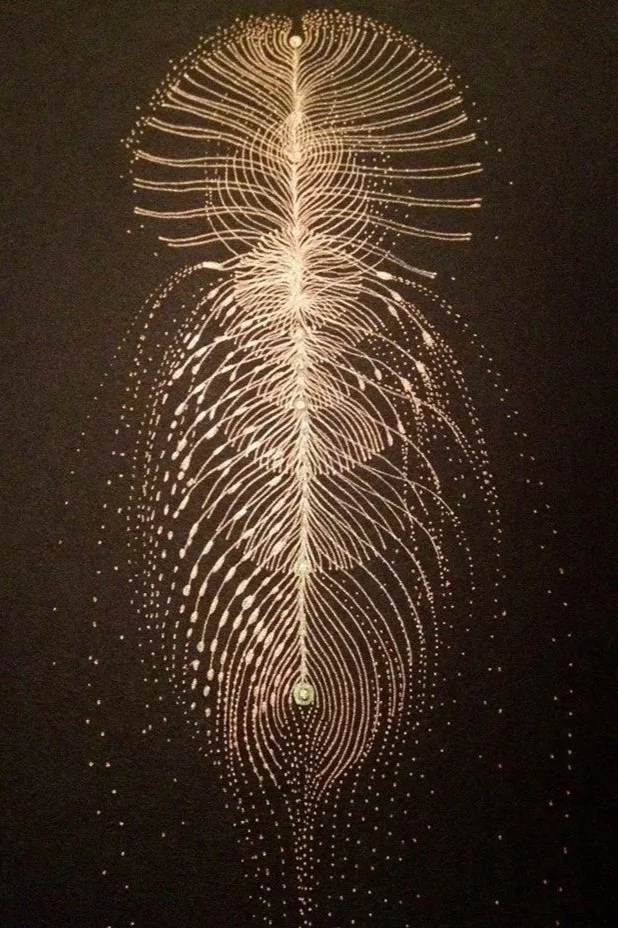
You are more than the contents of your mind
There is something deeply freeing to me about this.
This is your body.
This is your temperament.
This is your personality.
This is your history.
These are the people who raised you and the experiences that shaped you. This is the particular location and strange little sliver of human history into which you happened to arrive.
You did not choose all of it.
And yet, within those realities, there remains this remarkable capacity to notice.
To choose.
To practice.
To move toward.
You do not need to become a person who never experiences fear, intrusive thoughts, grief, shame, anger, uncertainty or existential dread.
You couldn't.
You're human.
Mary Oliver's poem I Worried captures this beautifully. She moves through a series of fears—what might happen, what might be lost, what may lie beyond her control—before recognizing how little all that worrying actually accomplished.
I won't reproduce the poem here. Go read it. It's wonderful.
And perhaps that is part of the work:
Not creating a mind that never worries, but developing a different relationship with the mind that does.
Insight is the beginning. Then we move.
Therapy can absolutely help you understand why you are the way you are.
I love that part.
I love tracing patterns. I love language. I love asking why. I love the moment when something suddenly makes sense and a person realizes that a behavior they have hated in themselves may once have been an intelligent attempt to protect, connect or survive.
But I don't want therapy to stop there.
Eventually, insight has to encounter experience.
The cerebral meets the physical.
Thought meets emotion.
Awareness meets behavior.
The story we inherited meets the life we are actually trying to build.
We practice a different way of being.
Again.
And again.
And again.
And maybe that is what change actually looks like.
Not becoming unrecognizable to ourselves.
Not erasing every old thought, feeling or impulse.
Not finally understanding ourselves so perfectly that we never struggle again.
Maybe change is the moment when something familiar arises and, for the first time, we recognize:
Familiar does not mean inevitable.
The old response may still arrive first.
It just doesn't have to get the final word.

Macri, J. A., & Rogge, R. D. (2024).Examining domains of psychological flexibility and inflexibility as treatment mechanisms in acceptance and commitment therapy: A comprehensive systematic and meta-analytic review.Clinical Psychology Review, 110, 102432.
van de Kamp, M. M., et al. (2023).Body- and movement-oriented interventions for posttraumatic stress disorder: An updated systematic review and meta-analysis.Journal of Traumatic Stress, 36(5), 835–848.
Chalghaf et al. (2026).Psychological Flexibility and Mental Health: Theoretical Foundations, Empirical Support, and Applications Across Clinical Contexts.